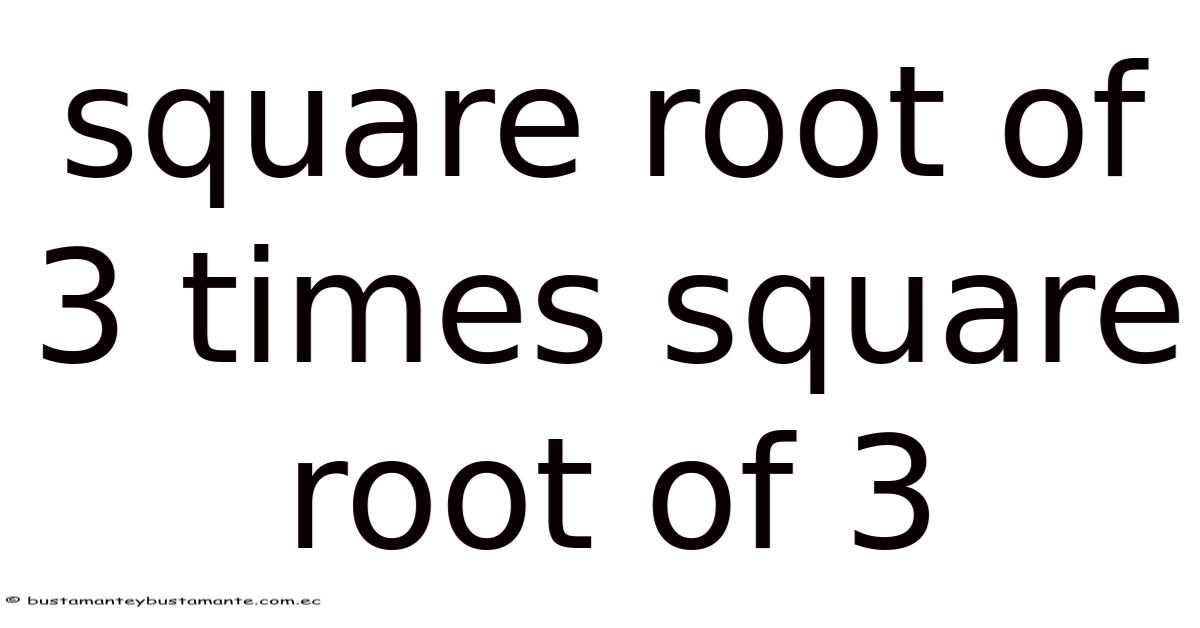
The scent of freshly brewed coffee filled the air as Sarah, a high school math teacher, scribbled equations on the whiteboard. Also, a hand shot up in the back. Worth adding: "Well, imagine you're designing a garden, and you need to calculate the area of a triangular flower bed. Which means simplifying radical expressions. Sarah, why do we even need to learn this? Practically speaking, her students, a mix of sleepy-eyed teenagers and eager learners, stared at the complex symbols. " Sarah smiled, recognizing the age-old question. "Ms. When will we ever use the square root of 3 times the square root of 3 in real life?Today's lesson? Understanding how to simplify radicals can be essential for accurate measurements.
Math, at its core, is a toolkit for solving problems. While some concepts might seem abstract at first, they often access solutions in unexpected ways. Understanding how to solve √3 * √3 is not just an exercise in arithmetic, but a gateway to understanding more complex mathematical relationships. " It might look like a simple math problem, but it's a foundational concept in algebra, geometry, and even fields like physics and engineering. Take the expression "square root of 3 times square root of 3.This article digs into the ins and outs of this fundamental operation, explaining why it works, its applications, and its significance in the broader world of mathematics Turns out it matters..
Main Subheading
Let's begin with the basics. To give you an idea, the square root of 9 is 3 because 3 * 3 = 9. This number is approximately 1.Think about it: the square root of a number is a value that, when multiplied by itself, gives you the original number. Which means the square root of 3, denoted as √3, is a number that, when multiplied by itself, equals 3. 732, but it is an irrational number, meaning its decimal representation goes on infinitely without repeating.
No fluff here — just what actually works.
When we consider "square root of 3 times square root of 3", or √3 * √3, we are essentially asking: what do we get when we multiply the square root of 3 by itself? This leads to the answer is straightforward: we get 3. This result is not just a coincidence but a fundamental property of square roots. Think about it: understanding why this is true is essential for grasping more advanced mathematical concepts. The process of multiplying a square root by itself effectively "undoes" the square root operation, leaving us with the original number under the radical Worth knowing..
And yeah — that's actually more nuanced than it sounds Easy to understand, harder to ignore..
Comprehensive Overview
To truly understand the significance of √3 * √3 = 3, let's explore the underlying mathematical principles and definitions.
Definition of Square Root
The square root of a number x is a value y such that y² = x. In mathematical notation: √x = y if and only if y² = x
In our case, √3 is the number that, when squared, equals 3. Mathematically: √3 = y if and only if y² = 3
Properties of Radicals
Radicals, including square roots, have several properties that govern how they can be manipulated. One key property relevant to our discussion is the multiplication property:
√(a) * √(b) = √(a * b)
This property states that the product of the square roots of two numbers is equal to the square root of their product. Applying this to our expression:
√3 * √3 = √(3 * 3) = √9
Since the square root of 9 is 3, we have:
√9 = 3
Because of this, √3 * √3 = 3
Proof Through Exponents
Another way to understand why √3 * √3 = 3 is by considering fractional exponents. The square root of a number can be expressed as that number raised to the power of 1/2. Therefore:
√3 = 3^(1/2)
So, √3 * √3 can be written as:
3^(1/2) * 3^(1/2)
Using the rule for multiplying exponents with the same base (a^m * a^n = a^(m+n)):
3^(1/2) * 3^(1/2) = 3^((1/2) + (1/2)) = 3^1 = 3
This approach provides a clear and concise proof that multiplying the square root of 3 by itself results in 3 That's the whole idea..
Geometric Interpretation
The concept of √3 * √3 = 3 also has a geometric interpretation. Consider a square with sides of length √3. The area of this square is calculated by multiplying the length of one side by itself:
Area = (√3) * (√3) = 3
This geometric representation illustrates that the product of √3 by itself gives the area of a square with side length √3, which is 3 square units That's the part that actually makes a difference..
Irrational Numbers and Exact Values
It's worth noting that √3 is an irrational number, meaning it cannot be expressed as a simple fraction and its decimal representation is non-repeating and non-terminating. Approximating √3 as 1.732 can be useful in some contexts, but it helps to recognize that this is an approximation.
When working with radicals, it's often preferable to keep them in their exact form (i.This ensures accuracy and avoids rounding errors. e.Now, , √3) rather than converting them to decimal approximations, especially when performing calculations. Multiplying √3 * √3 in its exact form directly yields 3, maintaining mathematical precision Not complicated — just consistent..
Trends and Latest Developments
While the concept of √3 * √3 = 3 is a fundamental mathematical principle, its application and relevance continue to evolve with advancements in technology and various fields of study.
Computational Mathematics
In computational mathematics, algorithms often involve complex calculations with radicals. And high-performance computing and software libraries rely on accurate and efficient methods for handling these operations. That said, the basic principle of √3 * √3 = 3 is a building block for more complex computations involving radical expressions and irrational numbers. As an example, in computer graphics, calculating distances and transformations often involves square roots, and optimizing these calculations is crucial for real-time rendering.
Cryptography
Cryptography, the art of secure communication, also utilizes mathematical principles involving radicals. While √3 itself may not be directly used in advanced cryptographic algorithms, the underlying concepts of number theory and algebraic manipulation are essential. Secure communication protocols often involve modular arithmetic and elliptic curves, which require a solid understanding of radical expressions and their properties Less friction, more output..
Physics and Engineering
In physics and engineering, √3 appears in various contexts, such as in calculations involving vectors, forces, and energy. Take this: in mechanics, the magnitude of a resultant vector can involve square roots of sums of squares, and simplifying these expressions often requires knowledge of radical properties. In electrical engineering, analyzing AC circuits and impedance can also involve complex numbers and radical expressions.
Data Analysis and Statistics
In data analysis and statistics, understanding the properties of radicals is important when dealing with standard deviations and variance. Because of that, these statistical measures often involve square roots, and accurate calculation and interpretation are essential for drawing meaningful conclusions from data. As data science continues to grow, efficient computation and manipulation of radical expressions remain relevant.
Educational Tools and Software
Modern educational tools and software are continually evolving to make math more accessible and engaging. Still, interactive simulations and visual aids can help students grasp the concept of √3 * √3 = 3 by providing visual representations and real-time feedback. These tools often incorporate gamification and personalized learning to cater to different learning styles.
Professional Insight
The latest trends indicate a growing emphasis on computational efficiency and accuracy in handling mathematical operations. Software developers and researchers are continually working to optimize algorithms and libraries for handling radicals and irrational numbers. This includes developing more efficient methods for simplifying expressions, reducing computational errors, and improving the performance of numerical simulations Nothing fancy..
The official docs gloss over this. That's a mistake.
Beyond that, there is a renewed focus on interdisciplinary applications of mathematics. As fields like data science, artificial intelligence, and quantum computing continue to advance, the need for a strong foundation in mathematical principles, including the manipulation of radicals, becomes even more critical.
You'll probably want to bookmark this section.
Tips and Expert Advice
Here are some practical tips and expert advice for working with square roots and radical expressions:
Simplify Before Calculating
Before performing any calculations with square roots, always simplify the expressions first. Here's the thing — for example, √12 can be simplified as √(4 * 3) = √4 * √3 = 2√3. In practice, look for perfect square factors within the radical. Simplifying first can make calculations easier and reduce the risk of errors Worth keeping that in mind..
Simplifying also helps in recognizing patterns and relationships. By reducing expressions to their simplest form, you can more easily compare and combine them. This is especially useful when solving equations involving radicals.
Rationalize the Denominator
When a radical appears in the denominator of a fraction, it's often desirable to rationalize the denominator. This means eliminating the radical from the denominator by multiplying both the numerator and the denominator by a suitable factor. Here's one way to look at it: to rationalize the denominator of 1/√3, multiply both the numerator and denominator by √3:
(1/√3) * (√3/√3) = √3/3
Rationalizing the denominator can make expressions easier to work with and compare. It also helps in avoiding potential rounding errors when approximating the value of the expression Still holds up..
Use Exact Values When Possible
When working with irrational numbers like √3, it's generally best to use exact values rather than decimal approximations. Decimal approximations can introduce rounding errors that accumulate over multiple calculations. Also, keeping the expression in its exact form (e. g., √3) ensures accuracy and avoids these errors.
If a decimal approximation is necessary, use a sufficient number of decimal places to minimize rounding errors. On the flip side, be aware that any decimal approximation is inherently an approximation and may not be suitable for all applications Small thing, real impact. Which is the point..
Understand the Properties of Radicals
A solid understanding of the properties of radicals is essential for manipulating and simplifying radical expressions. These properties include the multiplication property (√(a) * √(b) = √(a * b)), the division property (√(a/b) = √(a) / √(b)), and the power property ((√a)^n = √(a^n)) Less friction, more output..
Mastering these properties allows you to confidently manipulate radical expressions and solve equations involving radicals. Practice applying these properties in various contexts to reinforce your understanding.
Practice Regularly
Like any mathematical skill, proficiency in working with square roots and radical expressions requires regular practice. Work through a variety of examples and exercises to build your confidence and problem-solving skills. Focus on understanding the underlying concepts rather than memorizing formulas.
Regular practice will help you develop intuition for working with radicals and identify common patterns and pitfalls. It will also improve your speed and accuracy in performing calculations involving radicals It's one of those things that adds up..
FAQ
Q: What is the square root of 3? A: The square root of 3 (√3) is an irrational number that, when multiplied by itself, equals 3. Its approximate value is 1.732.
Q: Why is √3 an irrational number? A: √3 is irrational because it cannot be expressed as a simple fraction (a/b) where a and b are integers. Its decimal representation is non-repeating and non-terminating Surprisingly effective..
Q: How do you simplify √3 * √3? A: √3 * √3 = √(3 * 3) = √9 = 3. Alternatively, √3 * √3 = 3^(1/2) * 3^(1/2) = 3^1 = 3.
Q: Can √3 be expressed as a fraction? A: No, √3 cannot be expressed as a simple fraction. It is an irrational number.
Q: Where does √3 appear in real-world applications? A: √3 appears in various fields, including geometry (e.g., calculating the height of an equilateral triangle), physics (e.g., vector calculations), and engineering (e.g., analyzing AC circuits).
Conclusion
The short version: understanding that the square root of 3 times square root of 3 equals 3 is a fundamental concept in mathematics with broad applications. Day to day, it highlights the inverse relationship between squaring and taking the square root, and it underscores the importance of understanding irrational numbers and their properties. From basic algebra to advanced calculations in physics, engineering, and computer science, this simple operation forms the bedrock of more complex problem-solving techniques Worth knowing..
Now that you have a comprehensive understanding of √3 * √3, challenge yourself to explore further. Try simplifying more complex radical expressions, or investigate how square roots are used in different fields of study. Leave a comment below sharing how you've encountered square roots in your own learning or professional experiences. Happy calculating!
