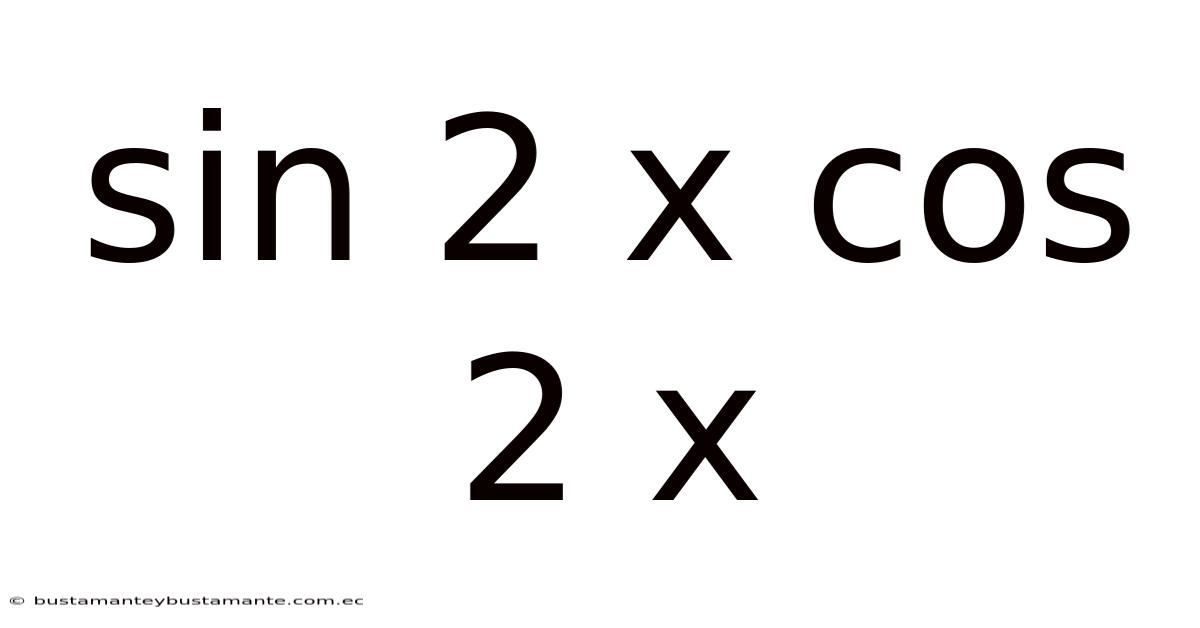
Imagine you're gazing up at a perfectly symmetrical butterfly, each wing mirroring the other in an complex dance of color and form. That inherent symmetry, that balance, is what makes it beautiful and captivating. Similarly, in the realm of mathematics, certain functions exhibit a graceful symmetry, their relationships woven together in elegant equations. Among these, the functions sin 2x and cos 2x stand out, not just as fundamental trigonometric entities, but as cornerstones for understanding more complex mathematical concepts.
Just as a kaleidoscope transforms simple mirrors into breathtaking patterns, trigonometric identities manipulate seemingly basic functions to reveal hidden connections. In real terms, the product of sin 2x and cos 2x, far from being a mere mathematical expression, unlocks a pathway to simplifying equations, solving integrals, and even modeling physical phenomena. Here's the thing — understanding the nuances of this product allows us to appreciate the underlying harmony within the mathematical universe, where everything is interconnected, and even the most complex problems can be broken down into manageable, elegant components. This article will explore the intricacies of sin 2x cos 2x, revealing its properties, applications, and its significance in the broader context of mathematics.
Exploring the Depths of sin 2x cos 2x
The expression sin 2x cos 2x might appear simple at first glance, but it holds significant depth and serves as a crucial building block in trigonometry and calculus. That's why its utility stems from its relationship to the double-angle formulas and its ability to simplify complex expressions. Now, before we dive deep, let's establish a clear context: trigonometric functions like sine and cosine are fundamental in describing cyclical phenomena, from the swing of a pendulum to the propagation of light waves. Understanding how these functions interact, especially in the form of sin 2x cos 2x, provides a powerful toolkit for analyzing and modeling these phenomena.
At its core, sin 2x cos 2x is a product of two trigonometric functions, each involving a double angle. To give you an idea, it is intrinsically linked to the sine of a quadruple angle, which opens doors to various simplification and problem-solving techniques. This immediately suggests the potential application of double-angle identities to simplify the expression. Understanding the behavior of this product also involves recognizing its symmetrical properties and its relationship to other trigonometric functions. By exploring its properties, we can not only simplify complex expressions but also gain deeper insight into the underlying relationships within the trigonometric world Most people skip this — try not to. Practical, not theoretical..
Comprehensive Overview: Unraveling the Mathematical Foundation
To truly grasp the significance of sin 2x cos 2x, it's essential to dig into its mathematical underpinnings. This includes understanding the definitions of sine and cosine, the double-angle formulas, and how these concepts interact to shape the behavior of the expression That's the part that actually makes a difference..
And yeah — that's actually more nuanced than it sounds That's the part that actually makes a difference..
Let's begin with the fundamental definitions. On the flip side, in a right-angled triangle, the sine of an angle is defined as the ratio of the length of the opposite side to the length of the hypotenuse, while the cosine is the ratio of the adjacent side to the hypotenuse. These ratios are not limited to triangles; they can be extended to any angle using the unit circle definition, where sin θ represents the y-coordinate and cos θ represents the x-coordinate of a point on the unit circle corresponding to the angle θ.
The double-angle formulas are critical to understanding and manipulating sin 2x cos 2x. The relevant formulas are:
- sin 2x = 2 sin x cos x
- cos 2x = cos²x - sin²x
These formulas are derived using trigonometric identities and geometric arguments, and they let us express trigonometric functions of double angles in terms of functions of the single angle Most people skip this — try not to..
Now, consider the expression sin 2x cos 2x. Using the double-angle formula for sine, we can rewrite it as:
(2 sin x cos x) cos 2x
This form highlights the interaction between the sine and cosine functions. Recall the double-angle formula: sin 2θ = 2 sin θ cos θ. That said, a more insightful simplification comes from recognizing a connection to the sine of a quadruple angle. If we let θ = 2x, then we have sin 4x = 2 sin 2x cos 2x.
sin 2x cos 2x = (1/2) sin 4x
This transformation is fundamental. Practically speaking, this identity not only simplifies calculations but also reveals a deeper harmonic relationship. It shows that the product of sin 2x and cos 2x is directly proportional to the sine of four times the angle x. Recognizing this relationship allows for easier manipulation and integration of expressions involving sin 2x cos 2x.
Beyond that, understanding the graphical representation of sin 2x cos 2x can provide additional insights. Plus, this means the function oscillates more rapidly than sin x or sin 2x, completing a full cycle in half the time. The graph of y = (1/2) sin 4x is a sine wave with an amplitude of 1/2 and a period of π/2. This rapid oscillation reflects the quadruple angle in the sine function Nothing fancy..
The historical context of these trigonometric identities is also worth noting. Mathematicians like Ptolemy and Hipparchus developed trigonometric tables and identities to solve problems related to celestial mechanics. Trigonometry has ancient roots, with early applications in astronomy and navigation. The double-angle formulas and their applications have been refined over centuries, becoming essential tools in various fields of science and engineering It's one of those things that adds up..
Trends and Latest Developments in Trigonometric Applications
While the fundamental principles of trigonometry, including the manipulation of sin 2x cos 2x, remain constant, their applications are continuously evolving with advancements in technology and scientific understanding. Here are some trends and developments:
-
Signal Processing: Trigonometric functions are the backbone of signal processing. The ability to simplify and manipulate expressions like sin 2x cos 2x is crucial in analyzing and synthesizing signals. Modern applications range from audio and video compression to wireless communication. Advanced techniques like Fourier analysis rely heavily on trigonometric identities to decompose complex signals into simpler components.
-
Quantum Mechanics: In quantum mechanics, wave functions often involve trigonometric functions. The behavior of particles at the quantum level can be modeled using sine and cosine waves. Simplifying expressions involving these functions is essential for solving the Schrödinger equation and predicting particle behavior. As an example, understanding the interference patterns of quantum particles often involves manipulating trigonometric identities Worth knowing..
-
Medical Imaging: Techniques like MRI and CT scans use trigonometric functions to reconstruct images from data. The raw data collected in these scans is often transformed using Fourier transforms, which rely heavily on trigonometric identities. Simplifying expressions involving sin 2x and cos 2x can optimize image reconstruction algorithms, leading to clearer and more detailed medical images Turns out it matters..
-
Computer Graphics and Animation: Trigonometric functions are fundamental in computer graphics for creating realistic animations and simulations. Rotations, scaling, and other transformations are often implemented using trigonometric functions. Simplifying expressions like sin 2x cos 2x can optimize the performance of these algorithms, especially in real-time applications like video games.
-
Machine Learning: While less direct, trigonometric functions play a role in certain machine learning algorithms, particularly in areas like time series analysis and signal processing. To give you an idea, recurrent neural networks (RNNs) can use trigonometric functions to model cyclical patterns in data. Optimizing these models may involve simplifying expressions related to trigonometric functions Took long enough..
Professional insight suggests that the ongoing development of computational tools and algorithms will continue to drive innovation in the application of trigonometric functions. As an example, quantum computing may provide new ways to perform complex trigonometric calculations, opening up possibilities for new applications in various fields. Here's the thing — as technology advances, the ability to efficiently manipulate and simplify trigonometric expressions will become even more critical. Beyond that, the integration of artificial intelligence and machine learning with trigonometric analysis could lead to breakthroughs in areas like predictive modeling and pattern recognition That alone is useful..
Tips and Expert Advice for Mastering Trigonometric Simplification
Mastering the simplification and manipulation of trigonometric expressions, especially those involving sin 2x cos 2x, requires a combination of theoretical knowledge and practical skills. Here are some tips and expert advice:
-
Memorize Key Identities: The foundation of trigonometric simplification lies in memorizing essential identities, including the double-angle formulas, Pythagorean identities, and sum/difference formulas. Having these identities readily available will significantly speed up the simplification process Worth knowing..
- Example: When encountering sin 2x cos 2x, immediately recognizing the potential to use the identity sin 4x = 2 sin 2x cos 2x is crucial.
-
Practice Regularly: Like any mathematical skill, proficiency in trigonometric simplification comes with practice. Solve a variety of problems to become comfortable with different techniques and approaches Not complicated — just consistent. And it works..
- Example: Work through exercises involving simplification, integration, and differentiation of expressions containing sin 2x cos 2x.
-
Recognize Patterns: Develop the ability to recognize patterns in trigonometric expressions. This will help you identify the appropriate identities and techniques to use.
- Example: Notice when an expression can be rewritten in terms of sin 2x, cos 2x, or tan 2x, and apply the corresponding double-angle formulas.
-
Use Substitution Strategically: Substitution can be a powerful tool for simplifying complex trigonometric expressions. Choose substitutions that will reduce the complexity of the expression and make it easier to manipulate.
- Example: If you encounter an expression with sin²x and cos²x, consider using the Pythagorean identity sin²x + cos²x = 1 to substitute one in terms of the other.
-
Break Down Complex Problems: When faced with a complex problem, break it down into smaller, more manageable parts. This will make the problem less intimidating and easier to solve.
- Example: If you need to integrate an expression involving sin 2x cos 2x, first simplify the expression using the identity sin 2x cos 2x = (1/2) sin 4x, and then integrate the simplified expression.
-
Use Technology Wisely: While it helps to develop manual skills, technology can be a valuable tool for checking your work and exploring complex trigonometric expressions. Use graphing calculators, computer algebra systems, or online tools to visualize functions and verify your solutions.
- Example: Use a graphing calculator to plot the graph of y = sin 2x cos 2x and compare it to the graph of y = (1/2) sin 4x to confirm the identity.
-
Understand the Context: Consider the context in which the trigonometric expression arises. This can provide clues about the appropriate simplification techniques to use.
- Example: If you are working on a problem in physics involving oscillatory motion, you might need to express the expression in terms of sines and cosines to analyze the frequency and amplitude of the motion.
-
Review Fundamental Concepts: Make sure you have a solid understanding of the fundamental concepts of trigonometry, including the definitions of sine, cosine, tangent, and their inverses.
- Example: Be comfortable with the unit circle definition of trigonometric functions and the relationships between angles and coordinates.
By following these tips and consistently practicing, you can develop the skills and knowledge necessary to master trigonometric simplification and effectively manipulate expressions involving sin 2x cos 2x Simple, but easy to overlook..
FAQ: Addressing Common Questions
Q: What is the simplified form of sin 2x cos 2x?
A: The simplified form of sin 2x cos 2x is (1/2) sin 4x. This is derived using the double-angle formula for sine: sin 2θ = 2 sin θ cos θ, where θ = 2x Worth keeping that in mind..
Q: How is the identity sin 2x cos 2x = (1/2) sin 4x useful?
A: This identity is useful for simplifying complex trigonometric expressions, solving integrals, and analyzing oscillatory phenomena. It allows you to express the product of sin 2x and cos 2x in terms of a single sine function with a quadruple angle, making it easier to manipulate and work with Simple, but easy to overlook. Nothing fancy..
Q: Can sin 2x cos 2x be expressed in terms of cosine only?
A: While it can be indirectly expressed using other trigonometric identities, the most direct simplification involves the sine function. Converting it solely to cosine would typically increase complexity rather than simplify it Most people skip this — try not to..
Q: What are some real-world applications of simplifying sin 2x cos 2x?
A: Simplifying sin 2x cos 2x has applications in signal processing, quantum mechanics, medical imaging, computer graphics, and machine learning. It is used to analyze and synthesize signals, model particle behavior, reconstruct images, optimize graphics algorithms, and model cyclical patterns in data.
Q: How does the graph of y = sin 2x cos 2x compare to the graph of y = sin x?
A: The graph of y = sin 2x cos 2x is a sine wave with an amplitude of 1/2 and a period of π/2, while the graph of y = sin x has an amplitude of 1 and a period of 2π. What this tells us is y = sin 2x cos 2x oscillates more rapidly and has a smaller amplitude than y = sin x Most people skip this — try not to..
Conclusion: Embracing the Power of Trigonometric Relationships
Boiling it down, the expression sin 2x cos 2x is more than just a product of trigonometric functions; it is a gateway to understanding deeper relationships within mathematics. Its simplified form, (1/2) sin 4x, reveals a direct connection to the sine of a quadruple angle, which allows for easier manipulation and integration in various applications. From signal processing to quantum mechanics, the ability to simplify and work with sin 2x cos 2x is invaluable in solving complex problems and modeling real-world phenomena.
By mastering the identities and techniques discussed in this article, you can enhance your understanding of trigonometry and its applications. Whether you are a student, engineer, or scientist, the ability to manipulate trigonometric expressions will empower you to tackle challenging problems and gain deeper insights into the world around you.
Now, put your knowledge into practice! Try simplifying other complex trigonometric expressions, explore different applications of sin 2x cos 2x, and share your insights with others. Engage with online communities, participate in discussions, and continue to expand your understanding of this fascinating area of mathematics. Your journey into the world of trigonometry has just begun, and the possibilities are endless.
Short version: it depends. Long version — keep reading.
