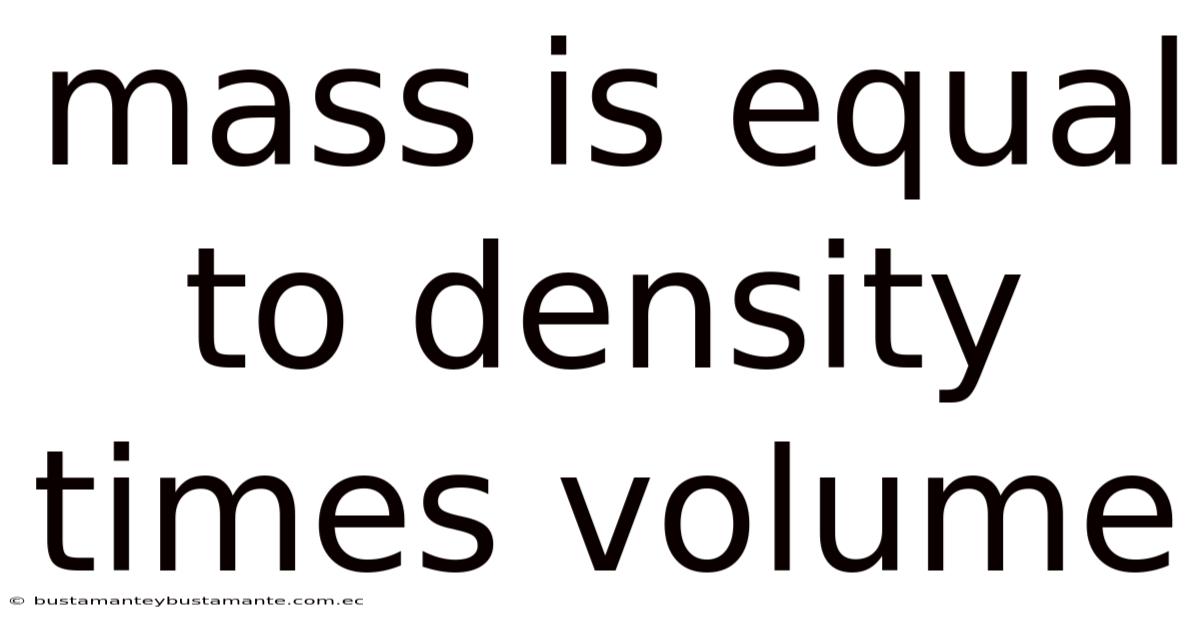
Have you ever picked up two objects of similar size, only to find that one feels much heavier than the other? These everyday experiences hint at a fundamental relationship in physics: **mass is equal to density times volume.Or wondered why some boats float while others sink, even if they're made of the same material? ** This simple equation, often written as m = ρV, is a cornerstone for understanding the physical properties of matter and how they interact in the world around us.
Imagine trying to pack a suitcase for a trip. In practice, you could fill it with fluffy pillows, or you could pack it with heavy books. Both take up the same volume inside the suitcase, but the suitcase filled with books would have a much greater mass. Worth adding: this difference arises because the books are much denser than the pillows; they pack more matter into the same amount of space. Understanding the relationship between mass, density, and volume isn't just about physics equations; it's about gaining a deeper insight into the world around you, from the materials that make up our buildings to the composition of planets and stars Surprisingly effective..
Unveiling the Equation: Mass is Equal to Density Times Volume
The formula m = ρV elegantly connects three fundamental properties of any object: its mass, its density, and its volume. To fully appreciate the significance of this relationship, we must first define each of these terms and explore their individual roles in describing matter. This equation allows us to predict how much "stuff" something contains based on how tightly that "stuff" is packed together and how much space it occupies Took long enough..
Some disagree here. Fair enough.
Decoding the Terms: Mass, Density, and Volume
-
Mass (m): Mass is a fundamental property of matter that measures its resistance to acceleration. In simpler terms, it's a measure of how much "stuff" is in an object. The more mass an object has, the harder it is to change its motion. Mass is typically measured in kilograms (kg) in the International System of Units (SI) or grams (g) in the centimeter-gram-second (CGS) system. make sure to distinguish mass from weight; weight is the force exerted on an object due to gravity, while mass is an intrinsic property of the object itself Worth keeping that in mind..
-
Density (ρ): Density is defined as mass per unit volume. It tells us how tightly packed the matter is within a given space. A dense object contains a large amount of mass in a small volume, while a less dense object contains less mass in the same volume. Density is commonly measured in kilograms per cubic meter (kg/m³) or grams per cubic centimeter (g/cm³). As an example, lead is much denser than wood, meaning that a piece of lead will have much more mass than a piece of wood of the same size.
-
Volume (V): Volume is the amount of three-dimensional space that an object occupies. It's essentially the size of the object. Volume is typically measured in cubic meters (m³) or liters (L) in the SI system, and cubic centimeters (cm³) in the CGS system. Calculating volume depends on the shape of the object; for regular shapes like cubes or spheres, there are simple geometric formulas. For irregular shapes, methods like water displacement can be used to determine the volume Still holds up..
The Mathematical Foundation: m = ρV
The equation m = ρV mathematically expresses the direct relationship between mass, density, and volume. What this tells us is if you increase the density of an object while keeping the volume constant, the mass will increase proportionally. It states that the mass of an object is directly proportional to both its density and its volume. Similarly, if you increase the volume of an object while keeping the density constant, the mass will also increase proportionally That's the part that actually makes a difference. Surprisingly effective..
This equation can be rearranged to solve for density or volume if the other two quantities are known:
- Density (ρ) = Mass (m) / Volume (V)
- Volume (V) = Mass (m) / Density (ρ)
These rearranged formulas are equally important, allowing us to calculate any one of the three properties if we know the other two. As an example, if you have a rock of known mass and you can determine its volume by immersing it in water, you can calculate its density using the formula ρ = m/V And that's really what it comes down to. Still holds up..
A Historical Perspective
The concept of density and its relationship to mass and volume has been understood intuitively for centuries. Worth adding: his famous "Eureka! On the flip side, the formal mathematical expression m = ρV emerged alongside the development of modern physics and the standardization of units of measurement. Archimedes, the ancient Greek mathematician and inventor, is credited with discovering the principle of buoyancy, which is closely related to density. " moment came when he realized that the volume of water displaced by an object is equal to the object's volume, allowing him to determine the density of the king's crown and expose a goldsmith's fraud Worth knowing..
While Archimedes didn't explicitly write the equation m = ρV, his work laid the foundation for understanding the relationship between mass, volume, and density. Later scientists, like Galileo Galilei and Isaac Newton, further developed these concepts, leading to the formalization of the equation and its widespread use in scientific and engineering applications No workaround needed..
Honestly, this part trips people up more than it should.
Why This Equation Matters
The equation m = ρV isn't just a theoretical concept; it has practical applications in numerous fields. Here are a few examples:
-
Engineering: Engineers use this equation to calculate the mass of materials needed for construction projects, ensuring that structures can withstand the loads they will bear. They also use it to design vehicles and aircraft, optimizing their weight and performance.
-
Material Science: Material scientists use density measurements to characterize and identify different materials. Density can also provide insights into the composition and microstructure of materials.
-
Geology: Geologists use density to study the Earth's composition and structure. Variations in density can reveal information about the different layers of the Earth and the distribution of minerals.
-
Chemistry: Chemists use density to identify and purify substances. Density is also used in solution chemistry to calculate concentrations It's one of those things that adds up..
-
Everyday Life: We use the concepts of mass, density, and volume intuitively in our daily lives. To give you an idea, when cooking, we measure ingredients by volume (e.g., cups of flour) or mass (e.g., grams of sugar). We also use density to understand why some objects float and others sink Simple, but easy to overlook..
Trends and Latest Developments
The fundamental equation m = ρV remains constant, but how we measure and put to use mass, density, and volume is continually evolving due to technological advancements and new areas of scientific inquiry.
Advanced Measurement Techniques
Traditional methods for measuring density, such as using graduated cylinders and balances, are still widely used, but advanced techniques are providing more accurate and efficient measurements. Some of these include:
-
Digital Density Meters: These instruments use oscillating U-tube technology to measure the density of liquids and gases with high precision.
-
Pycnometry: This technique uses a specialized flask called a pycnometer to accurately determine the volume of irregular solids, allowing for precise density calculations.
-
Computed Tomography (CT) Scanning: CT scans can be used to determine the density distribution within an object, providing valuable information about its internal structure Most people skip this — try not to. That's the whole idea..
-
Laser-Induced Breakdown Spectroscopy (LIBS): LIBS can be used to determine the elemental composition of a material, which can then be used to estimate its density.
Applications in Emerging Fields
The principles of m = ρV are increasingly important in emerging fields such as:
-
Nanotechnology: At the nanoscale, the properties of materials can differ significantly from their bulk properties. Accurate measurements of mass, density, and volume are crucial for understanding and manipulating nanomaterials Not complicated — just consistent..
-
Materials Science: Research into new materials, such as composites and metamaterials, requires precise control over density and composition. The equation m = ρV is essential for designing and characterizing these materials No workaround needed..
-
Biomedical Engineering: Density measurements are used in medical imaging techniques, such as bone densitometry, to assess bone health. They are also used in drug delivery systems to control the release of medication Surprisingly effective..
Data-Driven Approaches
With the rise of big data and machine learning, there is a growing trend towards using data-driven approaches to predict and analyze density. By collecting large datasets of material properties and using machine learning algorithms, researchers can develop models that accurately predict the density of new materials based on their composition and structure. This can accelerate the discovery of new materials with desired properties Easy to understand, harder to ignore..
Quick note before moving on.
Shifting Perspectives on Density
While density is typically considered a bulk property, recent research has explored the concept of local density variations within materials. These variations can arise due to defects, impurities, or structural inhomogeneities. Understanding these local density variations is crucial for predicting the behavior of materials under extreme conditions, such as high pressure or temperature.
Tips and Expert Advice
Understanding and applying the equation m = ρV effectively requires careful attention to detail and a clear understanding of the underlying principles. Here are some practical tips and expert advice to help you master this fundamental concept:
Choose the Right Units
Consistency in units is absolutely crucial when working with the equation m = ρV. see to it that you are using compatible units for mass, density, and volume. The most common systems are:
- SI Units: Kilograms (kg) for mass, kilograms per cubic meter (kg/m³) for density, and cubic meters (m³) for volume.
- CGS Units: Grams (g) for mass, grams per cubic centimeter (g/cm³) for density, and cubic centimeters (cm³) for volume.
Mixing units can lead to significant errors in your calculations. If you are given values in different units, convert them to a consistent system before applying the equation. To give you an idea, if you have a mass in grams and a volume in cubic meters, convert the mass to kilograms or the volume to cubic centimeters before calculating the density.
This is where a lot of people lose the thread.
Account for Temperature and Pressure
Density is often temperature and pressure-dependent, especially for gases. When working with gases or liquids, be sure to specify the temperature and pressure at which the density is measured. If the temperature or pressure changes, the density will also change Nothing fancy..
As an example, the density of air decreases as temperature increases. This is why hot air rises; it is less dense than the surrounding cooler air. Now, similarly, the density of a gas increases as pressure increases. This is why compressed gases, such as those used in scuba diving tanks, have a much higher density than air at atmospheric pressure.
Easier said than done, but still worth knowing.
Use Significant Figures Appropriately
Pay attention to significant figures in your measurements and calculations. The number of significant figures in your final answer should be limited by the least precise measurement used in the calculation. As an example, if you measure the mass of an object to two significant figures and its volume to three significant figures, your calculated density should be rounded to two significant figures Less friction, more output..
You'll probably want to bookmark this section.
Using too many significant figures can give a false impression of accuracy, while using too few can discard valuable information. Follow the rules for significant figures carefully to check that your results are accurate and meaningful Turns out it matters..
Consider the Material's Phase
The density of a substance can vary significantly depending on its phase (solid, liquid, or gas). In practice, for example, water is much denser in its liquid form than in its gaseous form (steam). When working with the equation m = ρV, be sure to consider the phase of the material and use the appropriate density value.
In some cases, a substance can exist in multiple solid phases (allotropes) with different densities. Here's one way to look at it: carbon can exist as graphite or diamond, each with a different density It's one of those things that adds up..
Account for Porosity
For porous materials, such as sponges or soil, make sure to distinguish between the bulk density and the particle density. The bulk density is the mass of the material divided by its total volume, including the volume of the pores. The particle density is the mass of the solid particles divided by their volume, excluding the volume of the pores.
When using the equation m = ρV for porous materials, be sure to specify whether you are using the bulk density or the particle density. The choice depends on the application. Day to day, for example, if you are calculating the mass of soil needed to fill a container, you would use the bulk density. If you are studying the properties of the solid particles themselves, you would use the particle density Took long enough..
FAQ
-
Q: What is the difference between density and specific gravity?
- A: Density is the mass per unit volume of a substance, usually measured in kg/m³ or g/cm³. Specific gravity is the ratio of the density of a substance to the density of a reference substance, usually water for liquids and solids, and air for gases. Specific gravity is dimensionless.
-
Q: How does temperature affect density?
- A: Generally, as temperature increases, density decreases because the substance expands. That said, there are exceptions, such as water between 0°C and 4°C, where density increases with temperature.
-
Q: Can density be negative?
- A: Density is generally a positive value because mass and volume are typically positive. That said, in some theoretical contexts, negative density materials have been proposed, though they do not exist in nature.
-
Q: What is the density of water?
- A: The density of pure water is approximately 1000 kg/m³ or 1 g/cm³ at 4°C. This value can vary slightly depending on temperature and pressure.
-
Q: How is density used in real-world applications?
- A: Density is used in various applications, including determining the purity of substances, designing boats and aircraft, and identifying materials.
Conclusion
The equation mass is equal to density times volume, or m = ρV, is more than just a simple formula; it's a powerful tool for understanding the physical world. From engineering and materials science to everyday life, this equation provides a fundamental link between an object's mass, how tightly its matter is packed, and how much space it occupies. By mastering the concepts of mass, density, and volume, and by understanding the relationship between them, you can gain a deeper appreciation for the properties of matter and the forces that govern our universe But it adds up..
Now that you have a solid understanding of m = ρV, take the next step! Plus, explore how this equation is used in different fields, conduct your own experiments to measure density, and challenge yourself to solve real-world problems using these principles. Share your findings and insights with others, and let's continue to unravel the mysteries of the physical world together. What experiments will you try first?
