Have you ever been stumped by a seemingly complex math problem, feeling like you're navigating a maze with no exit? Consider this: it's a common experience, especially when trigonometric functions enter the equation. But what if I told you that many of these intimidating problems can be elegantly simplified with the right approach?
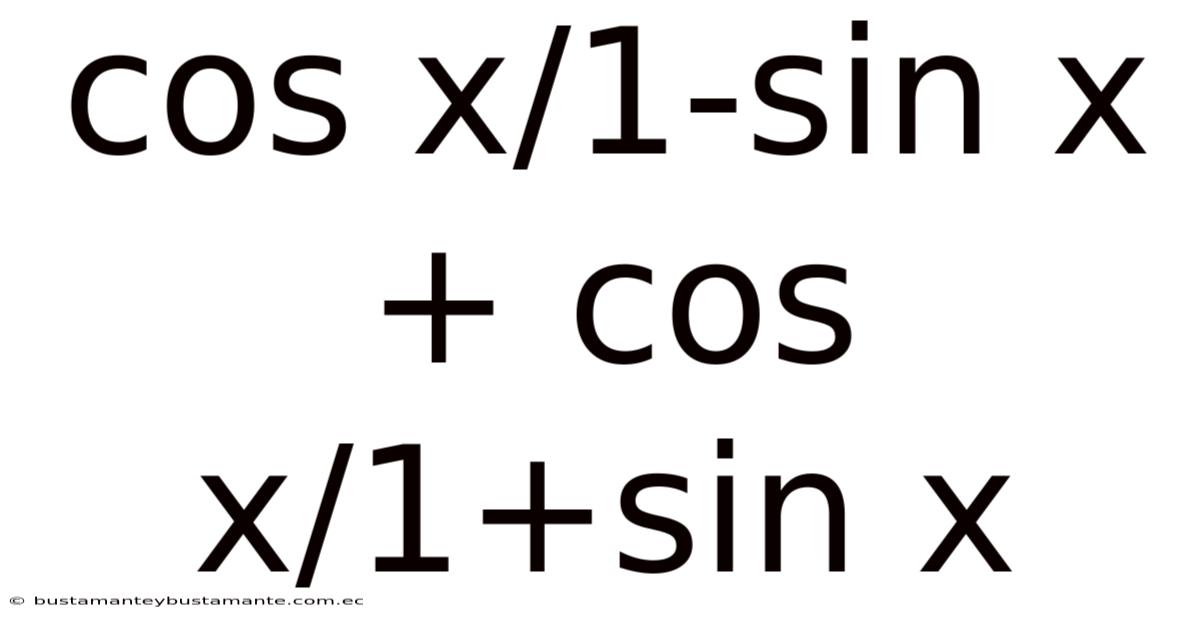
Imagine you're sitting in a math class, and the teacher writes on the board: cos x/1-sin x + cos x/1+sin x. That said, with a systematic approach and understanding of trigonometric identities, you can transform this complex expression into something surprisingly simple. Think about it: at first glance, it might seem daunting. This article will guide you through the process, providing a clear and comprehensive explanation that demystifies this trigonometric problem.
Main Subheading
The Beauty of Simplifying Trigonometric Expressions
Trigonometric expressions can often appear complicated and intimidating due to the presence of various functions such as sine, cosine, tangent, and their reciprocals. These functions describe the relationships between the angles and sides of triangles, playing a crucial role in various fields of science, engineering, and mathematics. Simplifying these expressions is not merely an academic exercise; it is a fundamental skill that allows for easier calculations, clearer insights, and more efficient problem-solving.
The expression cos x/1-sin x + cos x/1+sin x is a classic example of a problem that can be significantly simplified. That's why the key to simplification lies in leveraging trigonometric identities, algebraic manipulations, and a bit of mathematical intuition. By applying these tools effectively, you can transform a seemingly complex expression into a more manageable and understandable form. This not only makes the problem easier to solve but also enhances your understanding of the underlying trigonometric principles.
Comprehensive Overview
Understanding Trigonometric Functions and Identities
Before diving into the simplification of cos x/1-sin x + cos x/1+sin x, it's essential to have a solid understanding of the basic trigonometric functions and identities. Trigonometric functions, such as sine (sin x), cosine (cos x), and tangent (tan x), are defined as ratios of sides of a right-angled triangle. These functions relate an angle of a triangle to the ratios of two of its sides.
Definitions:
- Sine (sin x): The ratio of the length of the opposite side to the hypotenuse.
- Cosine (cos x): The ratio of the length of the adjacent side to the hypotenuse.
- Tangent (tan x): The ratio of the length of the opposite side to the adjacent side, or sin x / cos x.
Reciprocal Functions:
- Cosecant (csc x): The reciprocal of sine, i.e., 1 / sin x.
- Secant (sec x): The reciprocal of cosine, i.e., 1 / cos x.
- Cotangent (cot x): The reciprocal of tangent, i.e., 1 / tan x or cos x / sin x.
Key Trigonometric Identities:
- Pythagorean Identity: sin² x + cos² x = 1
- Tangent and Cotangent Identities:
- tan x = sin x / cos x
- cot x = cos x / sin x
- Reciprocal Identities:
- csc x = 1 / sin x
- sec x = 1 / cos x
- cot x = 1 / tan x
- Quotient Identities:
- tan x = sin x / cos x
- cot x = cos x / sin x
These identities are fundamental tools for simplifying trigonometric expressions. The Pythagorean identity, in particular, is widely used due to its versatility. It allows you to express sin² x in terms of cos² x (or vice versa) and is crucial in manipulating and simplifying various trigonometric equations But it adds up..
Historical Context: The roots of trigonometry can be traced back to ancient civilizations such as the Egyptians, Babylonians, and Greeks. These cultures used trigonometric ratios to solve practical problems related to astronomy, navigation, and construction. Hipparchus of Nicaea, a Greek astronomer, is often credited with developing the first trigonometric table. Later, mathematicians like Ptolemy made significant contributions, especially in astronomy Simple as that..
In the medieval period, Indian mathematicians further advanced trigonometry, introducing concepts such as sine and cosine. These ideas were later transmitted to the Islamic world and then to Europe, where trigonometry evolved into the sophisticated field we know today. The development of calculus in the 17th century provided even more powerful tools for analyzing trigonometric functions and their applications.
Importance in Various Fields: Trigonometry is not just an abstract mathematical concept; it has numerous practical applications. In physics, trigonometric functions are used to describe wave phenomena, such as sound waves and electromagnetic waves. They are also essential in mechanics for analyzing forces and motion.
In engineering, trigonometry is used in structural analysis, surveying, and signal processing. Because of that, architects and engineers use trigonometric principles to ensure the stability and accuracy of their designs. In computer graphics and game development, trigonometric functions are used to create realistic animations and simulations.
Detailed Simplification of cos x/1-sin x + cos x/1+sin x
Now, let's tackle the simplification of the expression cos x/1-sin x + cos x/1+sin x step by step.
Step 1: Combine the Fractions The first step is to combine the two fractions into a single fraction. To do this, find a common denominator, which in this case is (1 - sin x)(1 + sin x).
cos x / (1 - sin x) + cos x / (1 + sin x) = [cos x(1 + sin x) + cos x(1 - sin x)] / [(1 - sin x)(1 + sin x)]
Step 2: Expand the Numerator Next, expand the numerator by distributing cos x in both terms:
[cos x(1 + sin x) + cos x(1 - sin x)] = cos x + cos x sin x + cos x - cos x sin x
Step 3: Simplify the Numerator Notice that cos x sin x and -cos x sin x cancel each other out:
cos x + cos x sin x + cos x - cos x sin x = 2 cos x
Step 4: Expand the Denominator Now, expand the denominator (1 - sin x)(1 + sin x). This is a difference of squares:
(1 - sin x)(1 + sin x) = 1 - sin² x
Step 5: Use the Pythagorean Identity Recall the Pythagorean identity: sin² x + cos² x = 1. Rearranging this, we get:
1 - sin² x = cos² x
Step 6: Substitute into the Expression Substitute the simplified numerator and denominator back into the expression:
(2 cos x) / (cos² x)
Step 7: Simplify the Fraction Finally, simplify the fraction by canceling out a factor of cos x:
(2 cos x) / (cos² x) = 2 / cos x
Step 8: Express in Terms of Secant Since sec x = 1 / cos x, we can rewrite the expression as:
2 / cos x = 2 sec x
That's why, the simplified form of cos x/1-sin x + cos x/1+sin x is 2 sec x Small thing, real impact. Which is the point..
This step-by-step simplification demonstrates how a complex trigonometric expression can be reduced to a much simpler form by applying basic trigonometric identities and algebraic techniques. Understanding each step and the reasoning behind it is key to mastering trigonometric simplification Not complicated — just consistent..
Trends and Latest Developments
Advanced Simplification Techniques and Software
In modern mathematics and engineering, advanced techniques and software tools have revolutionized the way trigonometric expressions are simplified and analyzed. These developments allow for more complex problems to be tackled efficiently and accurately Not complicated — just consistent. That's the whole idea..
Computer Algebra Systems (CAS): Software like Mathematica, Maple, and MATLAB are widely used for symbolic computation. These systems can automatically simplify trigonometric expressions, solve equations, and perform calculus operations. CAS tools are invaluable for researchers and engineers who need to manipulate complex formulas quickly.
Machine Learning and AI: Artificial intelligence and machine learning algorithms are being used to identify patterns and simplify complex mathematical expressions. These techniques can discover new identities and simplification strategies that might be missed by human mathematicians. AI-driven tools are also being developed to assist in the automated derivation of mathematical formulas.
Fractional Calculus and Generalized Trigonometric Functions: Fractional calculus extends the concept of differentiation and integration to non-integer orders. This has led to the development of generalized trigonometric functions, which are used in various areas of physics and engineering, such as viscoelasticity and anomalous diffusion Most people skip this — try not to..
Quantum Computing: Quantum computing promises to solve problems that are intractable for classical computers. In the context of trigonometry, quantum algorithms could potentially be used to efficiently compute trigonometric functions with very high precision.
Tips and Expert Advice
Mastering Trigonometric Simplification: Practical Tips
Simplifying trigonometric expressions can be challenging, but with the right strategies and practice, it can become a manageable task. Here are some practical tips and expert advice to help you master this skill:
1. Know Your Identities: The foundation of simplifying trigonometric expressions is a solid understanding of trigonometric identities. Make sure you know the basic identities, such as the Pythagorean identity, reciprocal identities, and quotient identities. Create a reference sheet and memorize these identities to quickly recognize opportunities for simplification.
2. Look for Common Denominators: When dealing with fractions, the first step is often to find a common denominator. This allows you to combine fractions and simplify the resulting expression. Always look for opportunities to combine terms by finding a common denominator Most people skip this — try not to..
3. Factor and Cancel: Factoring expressions can reveal common factors that can be canceled out. This is a powerful technique for simplifying complex fractions and polynomials. Practice factoring different types of expressions to improve your pattern recognition skills.
4. Use the Pythagorean Identity Strategically: The Pythagorean identity (sin² x + cos² x = 1) is one of the most versatile tools for simplifying trigonometric expressions. Use it to express sin² x in terms of cos² x (or vice versa) and look for opportunities to substitute and simplify.
5. Practice Regularly: Like any mathematical skill, practice is essential for mastering trigonometric simplification. Work through a variety of problems, starting with simpler examples and gradually progressing to more complex ones. The more you practice, the more comfortable you will become with the techniques and strategies involved Simple as that..
6. Break Down Complex Problems: When faced with a complex expression, break it down into smaller, more manageable parts. Simplify each part separately and then combine the results. This can make the problem less overwhelming and easier to solve Easy to understand, harder to ignore..
7. Check Your Work: Always check your work to check that you have not made any errors. You can use a computer algebra system to verify your results or substitute numerical values to check if the original and simplified expressions are equivalent Surprisingly effective..
8. Seek Help When Needed: Don't be afraid to ask for help when you get stuck. Consult with your teacher, classmates, or online resources to get clarification and guidance. Learning from others can help you gain new insights and perspectives.
FAQ
Q: What is the most common mistake when simplifying trigonometric expressions?
A: One of the most common mistakes is not recognizing opportunities to apply trigonometric identities. Many students fail to memorize or fully understand the identities, which makes it difficult to spot situations where they can be used to simplify expressions.
Q: How can I improve my ability to recognize trigonometric identities?
A: Practice is key. Work through a variety of problems and focus on identifying the patterns and structures that indicate which identities can be applied. Create a reference sheet of common identities and refer to it regularly until you have memorized them No workaround needed..
Q: Are there any specific types of problems where simplification is particularly important?
A: Simplification is particularly important in calculus, where trigonometric expressions often need to be manipulated to find derivatives and integrals. It is also crucial in physics and engineering, where simplified expressions can lead to more efficient calculations and clearer insights.
Q: Can computer algebra systems completely replace manual simplification?
A: While computer algebra systems are powerful tools, they cannot completely replace manual simplification. Understanding the underlying principles and techniques is essential for interpreting the results of CAS and for solving problems where CAS tools are not available. Additionally, manual simplification can often provide deeper insights into the structure and properties of the expressions Worth keeping that in mind. But it adds up..
Q: What resources are available for learning more about trigonometric simplification?
A: There are many excellent resources available, including textbooks, online tutorials, and video lectures. Websites like Khan Academy and Coursera offer comprehensive courses on trigonometry and calculus. Additionally, many universities and colleges provide online resources and practice problems.
Conclusion
Simplifying trigonometric expressions like cos x/1-sin x + cos x/1+sin x is a fundamental skill that enhances your understanding of trigonometry and its applications. But by mastering the basic trigonometric functions, identities, and algebraic techniques, you can transform complex expressions into simpler, more manageable forms. This not only makes problem-solving easier but also provides deeper insights into the underlying mathematical principles.
Remember, the key to success lies in practice, patience, and a willingness to explore different approaches. So, continue to hone your skills, explore new problems, and embrace the beauty of trigonometric simplification.
Ready to put your skills to the test? Try simplifying similar trigonometric expressions on your own. Share your solutions and insights in the comments below, and let's continue learning together!
